How the clouds are made
Switch on the clouds and you might expect a sky like Earth's. What you get is a few thin streaks with the stars shining through, and on most planets nothing at all. That isn't a bug or a missing feature. Elite works its planets out from physics, EDCAS works the clouds out the same way from each planet's scan, and the planets you can land on have very little air. The rest of this page goes through how the client gets from a scan to a sky, and why the big clouds stay away.
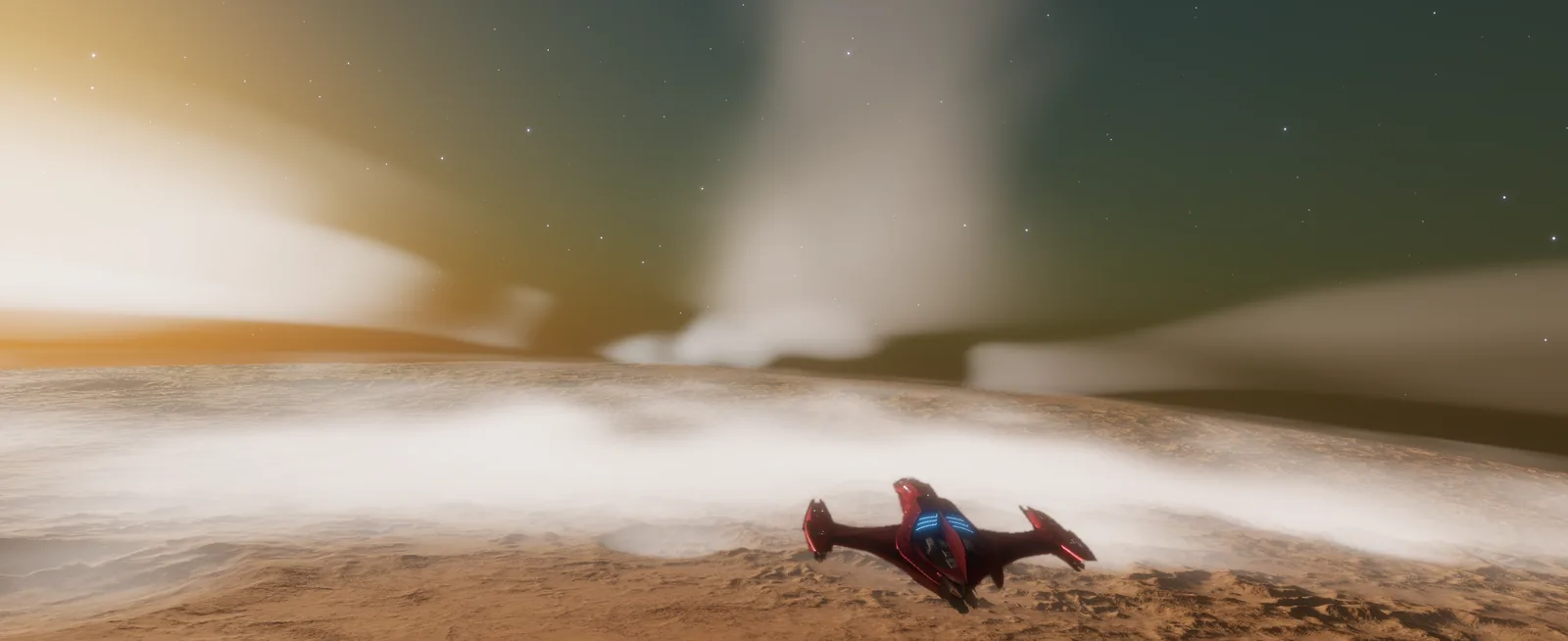
The short version
A cloud can only be made of what the air carries, and air this thin doesn't carry much. You still get something for it: veils of ice, fog that lies in the low ground at dawn, and high clouds that keep glowing after the sun has set. For the tall white heaps we know from Earth you would need about a hundred times more air and a lot of water in it, and no planet you can land on has that.
From the scan to the sky
The client reads the scan
When you fly up to a planet, the client picks its scan out of your journal. It needs the gases in the air and how much there is of each, the pressure and temperature at the ground, the gravity, and whether the planet is tidally locked. That is all it uses, so two planets with the same scan end up with the same sky.
It looks up where each gas freezes
Every gas has a temperature below which it comes out of the air as ice crystals, called the frost point. Where that lies depends on how much of the gas there is: the less of it, the colder it has to get. The client calculates it for nine gases, from water all the way down to neon. Helium and hydrogen are not on the list, because no planet gets cold enough for them.
Each line shows where a gas freezes. Below its line the gas comes out of the air as ice. The white dots are Mars at its ground temperature, once for its water and once for its carbon dioxide, and the gap from a dot down to the line is what the next step calls the margin. Mars is only 9 K above the line for its little bit of water, which gives it low ice clouds and fog at dawn. It is 64 K above the line for its carbon dioxide, which gives it faint clouds very high up. The real Mars has both. It compares that with the planet's temperature
The number that matters is how many kelvins the ground is above a gas's frost point. This page calls it the margin. The gas with the smallest margin is the one that makes the planet's clouds, and the size of the margin decides what kind they are.
0 to 20 KLow deck and ground fog
The gas is always on the edge of freezing. You get a low, broken layer of cloud, frost, and fog in the low ground at night.
20 to 90 KVeil or high clouds
If it is a trace gas that still freezes on the night side, it makes a thin, streaky veil. If it is the main gas, it only freezes very high up, and you get a few faint clouds around dawn and dusk.
over 90 KClear sky
Too warm, at any height. This is where most planets with air end up, for every gas they have.
It works out how much cloud there is
A cloud can't weigh more than the vapour that was in the air to begin with. The air above one square metre weighs its pressure divided by the gravity. The gas makes up its share of that, and only part of the gas condenses. So the denser clouds are on planets with more air, more of the gas, or lower gravity.
cloud mass per m² = condensed share × the gas's share × pressure ÷ gravity
How visible that ends up on screen is matched to Mars. Even if you look straight up through the thickest patch, about two thirds of the light still gets through at the default strength, so you see the stars through the clouds just as you would there.
It puts them in the sky
The heights come from the air's scale height, which is larger on warm planets and smaller on heavy ones. A low deck sits near the ground, a veil one to four scale heights up, and the main gas's clouds five scale heights up. They drift with the wind at their height, anywhere from 5 to 80 m/s, and slowly change shape on the way.
How much of the sky is covered depends on the local time. Thin air cools down and warms up quickly, so there is most cloud at dawn, at dusk and at night, and least at noon. The clouds are ice lit by the sun, so they take the colour of the star and go dark after sunset. The highest ones stay lit the longest.
Why there are no huge clouds
1. The air is too thin to hold them
A thick grey overcast, like on a rainy day on Earth, has kilograms of water above every square metre. If you froze all the water out of the air on Mars, you would get a layer a hundredth of a millimetre thick.
2. Nothing drives them upwards
A big cumulus cloud builds itself. When vapour condenses it gives off heat, the warmer air rises, and as it rises more vapour condenses. On Earth this heats the rising air by about 30 K, which is enough to pile clouds up 10 km high. In thin, cold air only about a ten-thousandth of the air is vapour, so the heating is a fraction of a degree and the cloud stays a flat layer.
3. It can't rain
Below that pressure water is either ice or vapour, so there are no droplets, no rain and no rain clouds. What does happen is that ice crystals fall out of a veil in streaks and turn back into vapour before they reach the ground.
None of this is only theory. Probes have had a close look at four worlds with thin air, and not one of them showed a cumulus tower, an anvil or a thick overcast. What they did show is pretty much what EDCAS draws.
What the real ones look like
Mars
Has veils of water ice in a belt around the equator, thickest in the morning and evening, and fog in its canyons at dawn. Its carbon dioxide clouds are 60 to 85 km up and still glow after sunset.
Pluto
Has about twenty thin layers of haze reaching up to 200 km, made by sunlight from methane and nitrogen. Seen against the sun the haze is blue. Possible clouds were only spotted near the edge of night.
Triton
Has thin, bright clouds of nitrogen ice a few kilometres up and haze up to 30 km. Its geysers rise 8 km and then get blown 150 km downwind into a flat streak.
Io
Its sulphur dioxide air is so close to the frost point that it freezes onto the ground every night and comes back at sunrise.
What you can find
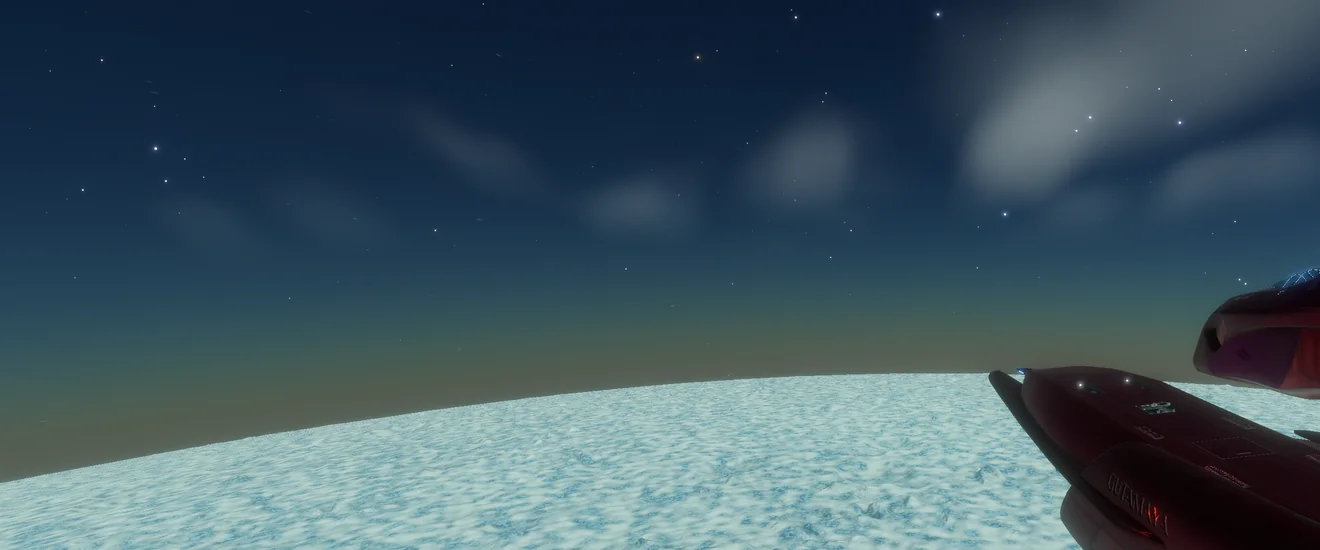
Low deck
like stratocumulusA broken layer close to the ground, on planets where a gas is within 20 K of freezing. At night it forms cells, and by day the wind pulls it into rows. Ground fog comes with it.
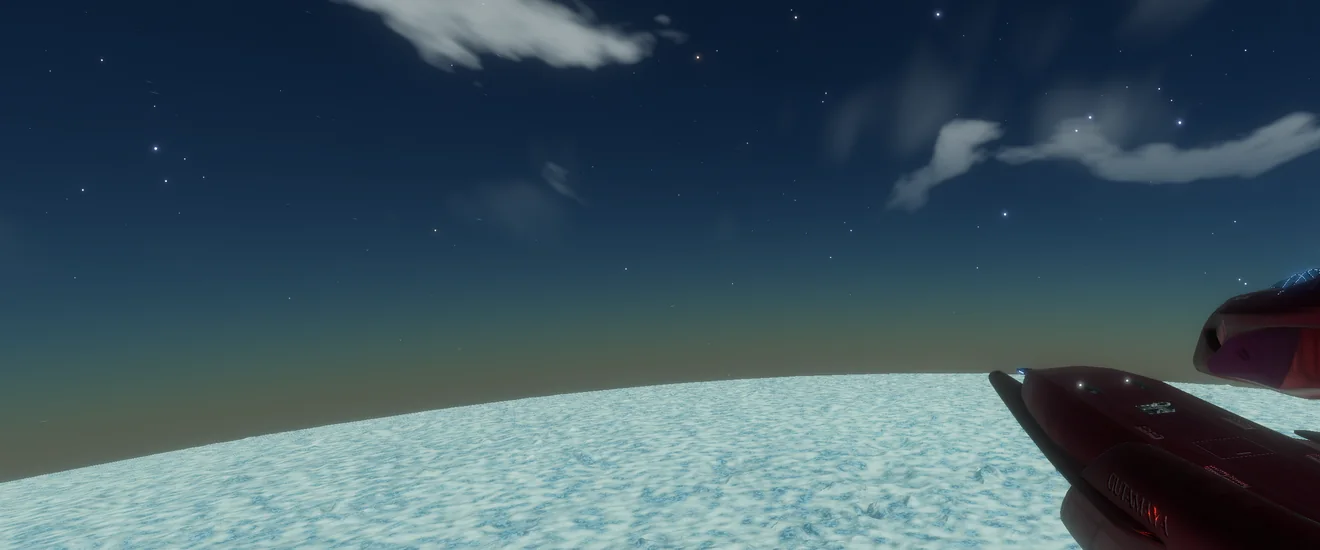
Thin veil
like cirrusThe faint wisps in this picture are ice of a trace gas, with fall streaks hanging below them. A veil of water ice that is wide and slow looks smooth instead and puts a ring of light around the sun. The bright filaments further up are the main gas's high clouds, so this sky has two layers, the way Mars does.
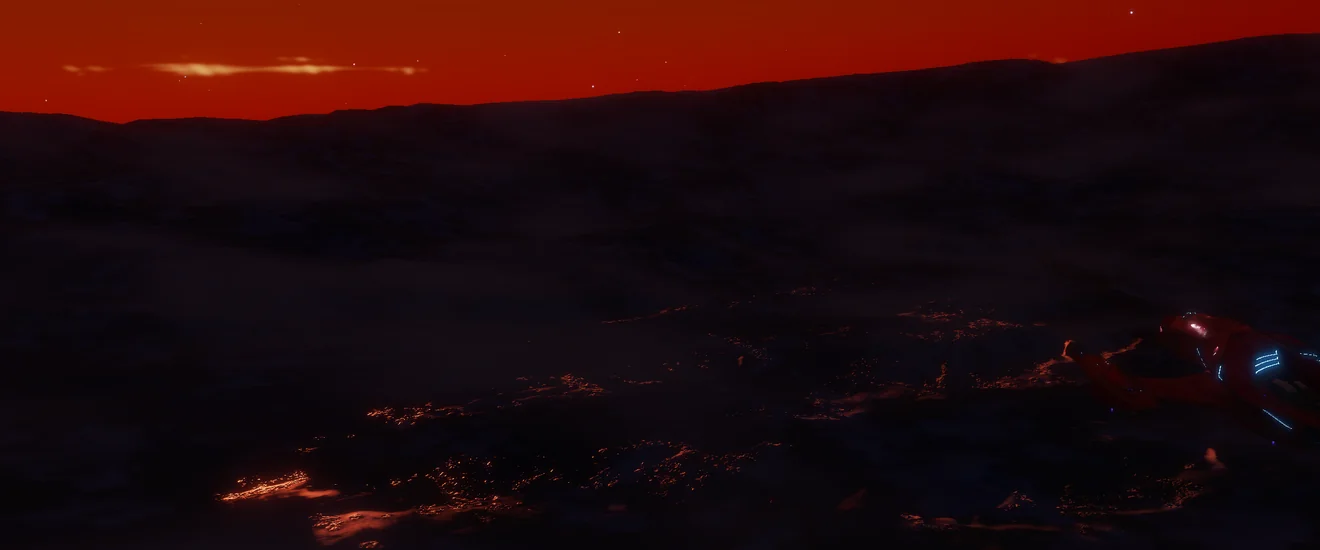
High clouds
like noctilucent cloudsThe planet's main gas, frozen five scale heights up. You hardly see them by day. After sunset they are still in sunlight while the ground is already dark, and they pick up a bit of mother-of-pearl colour.
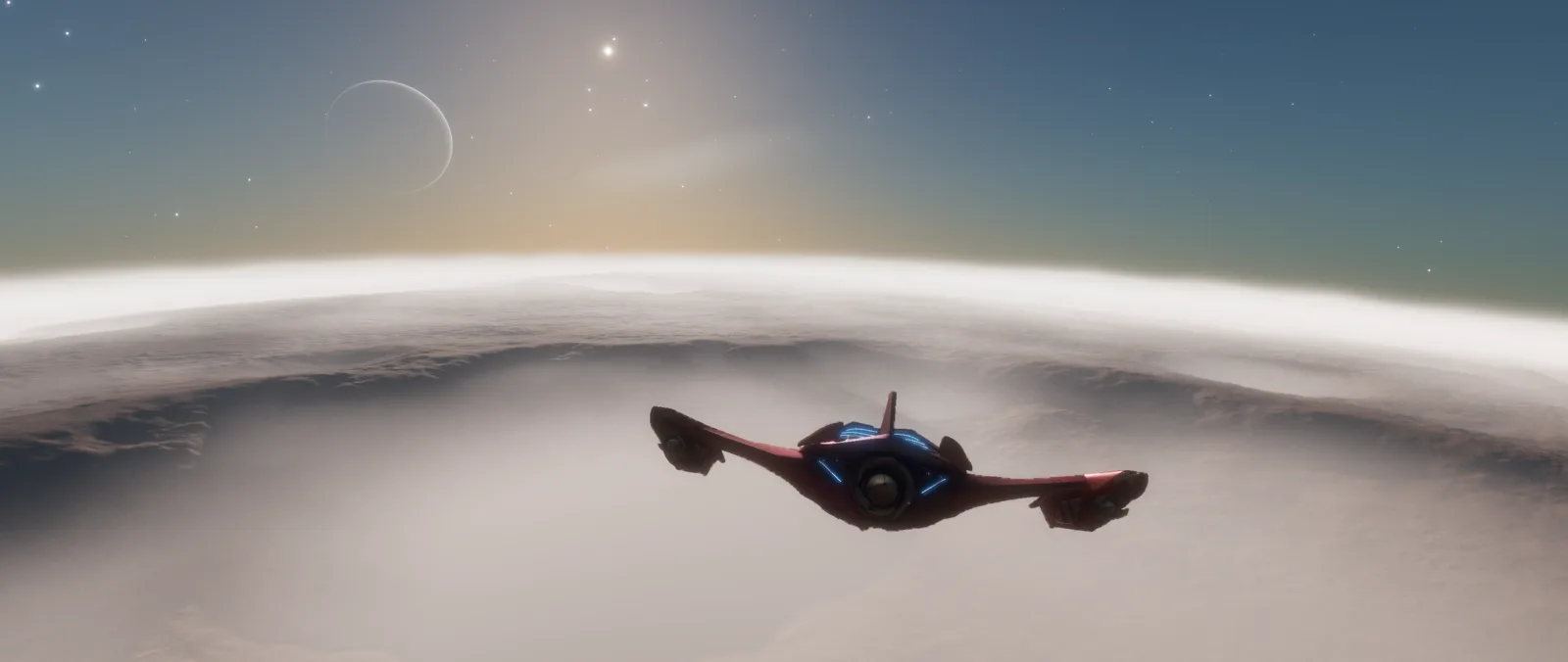
Ground fog
night to early morningForms where the air near the ground cools down to the frost point overnight. It collects in the lowest ground and is gone by the time the sun is about 20° up. Tidally locked planets have long nights and get more of it.
About the pictures: the first three are frames saved from the game and rendered again with the settings the client writes. For the low deck and the veil that is an example atmosphere of each kind, over the same view. The fog picture is a normal screenshot.
- Haze. Sunlight turns methane, ammonia or sulphur dioxide into a fine haze that you see along the horizon. Where methane meets nitrogen it is orange, as on Titan and Pluto. A planet can have haze without having clouds.
- What you won't find: cumulus heaps, thunderstorms with their anvils, rain, or a grey overcast. At these pressures they can't form.
- Most planets have none. A planet stays clear if it has no air, if none of its gases can freeze (helium, hydrogen), or if it is more than 90 K too warm for all of them.
- The client tells you. Under Settings → Game Graphics it says what the planet you are at gets, for example Clouds: carbon dioxide ice, low stratocumulus-like deck, scattered, with ground fog, or why it gets none.
The one thing that isn't pure physics
Which planets get clouds, from which gas, how high they are, how much of the sky they cover and which planet has more than another all comes out of the physics. How bright they are on screen is the exception. Taken strictly, a lot of these clouds would be too faint to notice in daylight, and then there would be little point in drawing them. So EDCAS draws them about as strong as on a good day on Mars, and keeps the differences between planets as they are.
If that is still too little for you, Cloud Strength under Settings → Game Graphics makes a planet's clouds easier to see. It won't put clouds on a planet whose air doesn't make any.

Elite Dangerous is a trademark of Frontier Developments plc. This is an unofficial, fan-made tool and is not affiliated with or endorsed by Frontier Developments.